Contact Us

Have an inquiry? Please send us a message.


123 Street Avenue, City Town, 99999

(123) 555-6789

email@address.com


You can set your address, phone number, email and site description in the settings tab.
Link to read me page with more information.

News

News from Elf, a digital creative agency at the intersection of the arts and sciences.

Filtering by Category: Industry Insight

CalTech & ETH Zurich Teams Aim to Harness Renewable Energy

Elf

Hydrogen and Helium Molecules

Hydrogen and Helium Molecules

Energy powers all human activity, ranging from electricity, air conditioning and heating in your home to the vehicles you drive or take to your destination. Since 2011, research teams at CalTech and ETH Zurich have been working together to harness and produce alternative forms of renewable energy and thus provide clean, renewable and abundant sources of energy to power all human activity.

Powered by the Sun, future fuels could consist of only sunlight, air and water and thus provide unlimited, clean and renewable energy for cars, laptops, GPS systems and daily household and commercial activities. One of the primary methods takes concentrated heat from the sun to convert water and CO2 into hydrogen (H2) or carbon monoxide (CO). Combining the two would make liquid fuel that could power daily activities. Researchers at ETH Zurich have been working to further develop a pure hydrogen model and thus avoid any complications associated with carbon production. The liquid fuels generated could also be used in fuel cells, as suggested by CalTech researcher Sossina Haile.
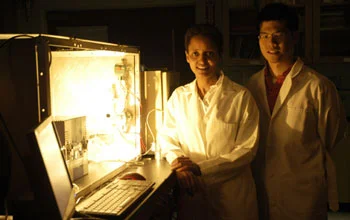
Sossina Haile and William Chueh next to the benchtop thermochemical reactor used to screen materials for implementation on the solar reactor. Image via CalTech

Sossina Haile and William Chueh next to the benchtop thermochemical reactor used to screen materials for implementation on the solar reactor. Image via CalTech

Converting H2O and CO2 into H2 and CO is a known process but doing it efficiently and cost-effectively has not been easy. Rare elements such as platinum or iridium have been used as catalyst so trigger the conversion.

Prof. Dr. Hansjörg Grützmacher and Dr. Monica Trincado. Image via ETH Zurich

Prof. Dr. Hansjörg Grützmacher and Dr. Monica Trincado. Image via ETH Zurich

Numerous projects are underway at ETH Zurich to find ways to harness hydrogen more efficiently and to produce solar fuels effectively. One of the most recent successful projects was completed by Prof. Grützmacher and his research group. The team discovered that formaldehyde can be used to store hydrogen.

Developing ways to harness renewable energy sources requires knowledge of how to first produce the fuel efficiently, then to store it and distribute it. The abundance of solar energy direct from the Sun makes it a very compelling choice. Finding the most effective way to do this would have tremendously beneficial results.



What's Your Carbon Footprint?

Elf

Carbon footprint is a term that has come into more common usage in the last decade. What does it mean? Let’s take a closer look.

Photo via Getty Images

Carbon footprint refers to the amount of carbon dioxide and other carbon compounds emitted due to the consumption of fossil fuels by a particular person, group, event, product or organization.

Typically, carbon footprint refers to the amount of greenhouse gases, especially carbon dioxide, released into the atmosphere by a particular human activity. Carbon footprint is usually measured as tons of CO2 emitted per year. This number increases when you add CO2-equivalent gases, such as methane, nitrous oxide and other greenhouse gases.

Consumption of fossil fuels and electricity play a large role in determining your carbon footprint.


How to Calculate Your Carbon Footprint

Your individual carbon footprint can be affected by many factors. Fossil fuel use and electricity consumption play a major role in your carbon footprint. Online calculators help in providing rough estimates based on factors such as:

• size of your household
• efficiency of appliances
• how much you drive or fly
• what you eat
• how much you recycle

While this is an approximation and not perfect, this can give you a good way to measure your activities and thus know how much CO2 you generate via these activities and and to figure out steps you can take to reduce your carbon footprint.

You can estimate your carbon footprint using these tools:
https://www.carbonfootprint.com/calculator.aspx
https://www3.epa.gov/carbon-footprint-calculator/


How can I reduce my carbon footprint?

Many daily activities such as electricity usage (home energy), car driving (transportation) and trash disposal (waste) all cause greenhouse gas emissions and contribute to your household's carbon footprint.

You can reduce your carbon footprint through your personal choices such as:

• driving more-efficient vehicles and maintaining existing vehicles
• using energy-efficient appliances
• insulating your home to reduce heating and air conditioning costs

Individuals and companies also purchase carbon credits to offset their usage. The money raised from this goes into projects such as planting trees or investing in renewable energy. Additional information and resources are available here: https://www.carbontrust.com/resources/guides/carbon-footprinting-and-reporting/carbon-footprinting


Try it Out: Get a Rough Estimate of Your Carbon Footprint

Debunking Some Myths on Design Thinking

Elf

Design Thinking is a Popular Term Adopted Rapidly Today that is Often Misunderstood. Let’s Take a Closer Look.

Image by Anna McNaughty

Image by Anna McNaughty

How do you break down and explain the process of creativity?

‘Design thinking’ is a popular term today. It was first introduced into the mainstream by the San Francisco consultancy IDEO in the early 1990s to explain its methodology for solving problems when working with clients. The phrase itself comes from Carnegie Mellon professor and Nobel Prize Laureate Herbert Simon, who wanted to explain the process of human creativity systematically. Since that time, the phrase has been adapted, modified, and expanded to fit a variety of approaches and roles. Unfortunately, many misconceptions regarding this term and the actual work of designers have arisen. Here we address some of the primary ones.

Design thinking is a term first coined by Herbert Simon, a professor at Carnegie Mellon, in 1969 to attempt to explain the process of human creativity systematically.

Interestingly enough, Herbert Simon was not a designer and did not create any visual works. He, however, was a pioneer in artificial intelligence.

“What can a human being do that a computer cannot?” Simon examined questions like this. The term ‘design thinking’ naturally arose out of this process as Simon and other computer scientists aimed to harness the

power of individual human creativity, but still wanted the familiarity of a repeatable, proven process.


Myth #1 The design process can be done by people who cannot design.

This assumption offers an interesting dilemma. Today there are increasing numbers of private companies offering to teach ‘Design Thinking’ at the corporate level and for universities without actually including any design or creative input. They seem to be avoiding and circumventing the actual creative process. While having the gift of communication (oral and written) is admirable, teaching ‘design thinking’ as a self-sufficient design practice without hands-on work using prerequisite design skills is inadequate. That eliminates the majority of actual design, which is hands-on and requires excellent individual skill. In essence, such training teaches the theory without the practice. It is similar to offering you how to paint by just talking about the process of painting and never actually painting. Perhaps their customers would be better and more honestly served by offering to teach them the theory of design thinking since that is what they are offering.

Herbert Simon did not downplay the value of creativity or design skills. He just sought a way to bring the creative conceptual thinking behind design into work processes. Simon aimed to open up the design ‘thinking’ process to people who were not designers and who stayed away from non-linear, non-scientific methods. He tried to bridge the gap in understanding. Using a ‘design thinking’ approach enabled businesses and organizations to look at problems differently and thus propose different solutions.

Fact: ‘Design thinking’ process works if you have skilled designers guiding the process. You cannot just talk your way through design - you have to do it. Actual design work requires tremendous skill, precision, craftsmanship, and a keen awareness of composition, beauty, and balance.

The value in having a design thinking approach lies in bringing an awareness and understanding of the creative process, soliciting feedback, and making design more accessible to businesses.


Image by Elf art director, quote by Goethe

Image by Elf art director, quote by Goethe

Myth #2 Design thinking replaces actual design.

By far, this assumption about design thinking is the most dangerous and misleading. Design thinking as an approach helps in providing insight into the process. Design involves both a conceptual aspect and a physical action in creating and fine-tuning artwork. When the conceptual part involves software or digital design work, the work can benefit from feedback from other designers and other company members involved with customer engagement. This initial collaborative step helps bring all parties involved in the decision-making process on the same page. Thus all necessary feedback and relevant data are gathered to make the best, informed decisions. For example, with a product that you are selling to consumers, this process can help you discover unmet needs and learn where people are dissatisfied with using the current version of your product. Design thinking thus enables cooperation and collaboration in the first step of discovery and research into the problem you are solving. This brainstorming process is helpful, but only as an initial step.

There is considerably more effort involved to take the ‘brainstormed’ idea from conception to completion. The remaining steps involve excellent design skills, precision, and craftsmanship with many iterative, detailed cycles till final delivery. The act of creation itself is an original process unique to the individuals involved who draw upon their creative abilities and experiences.

Fact: While a ‘design thinking’ approach opens up the initial discovery process and can bring all parties (clients, partners, company staff, and stakeholders) to a common understanding of what is needed to design a solution, design thinking never replaces the original process of creation itself. People who lack essential design skills cannot complete the design process beyond the discovery phase. Thinking or talking about design does not replace design skill, precision, and craftsmanship. Design is an original process that requires fundamental design skills.

Design is an original process that requires actual design and craftsmanship skills.


What then is the value of design thinking?

'Design thinking' is a great way to help explain the value of design and solicit feedback from people at a company during the discovery process. It is a way of explaining the process involved to bring people together on the same page. It offers a way to provide a consistent approach for creating new products or services for businesses.

Explaining the value of design can often feel intangible and be hard to put into words. This dilemma prompted us to research the topic and explain design results in actual monetary terms and the value of design regarding the bottom line for businesses. This article has been shared over 3,700 times. The most important lesson that we take away from that research is how integrating design into business practice leads to creating better, intuitive products, services, and experiences for customers.

Design is about providing an excellent, intuitive, and empathetic customer experience. So how does your customer experience your product or service?

Design thinking helps bridge the gap in understanding that often accompanies the creative design process. It offers a way to provide a consistent approach for creating new products or services for businesses.

When you design thoughtfully, considering what your customers need and want, you will create better products, services, and experiences.