Contact Us

Have an inquiry? Please send us a message.


123 Street Avenue, City Town, 99999

(123) 555-6789

email@address.com


You can set your address, phone number, email and site description in the settings tab.
Link to read me page with more information.

News

News from Elf, a digital creative agency at the intersection of the arts and sciences.

Filtering by Category: Industry Insight

Amazon Opens 2 New HQ on the East Coast: NYC and Arlington, VA

Elf

After almost a yearlong search with fierce competition among U.S. cities eager for the new business, Amazon settles on the Queens neighborhood in New York City and the city of Arlington, Virginia for its new HQ on the East Coast

Image via Amazon

Image via Amazon

It’s not every day that a tech giant builds a new headquarters. Amazon announced that the company was in search of a new American location to house a second HQ apart from its primary location in Seattle, Washington in 2017. Cities all over the country were eager to bring in Amazon to their states, thus ensuring new jobs and employment for their residents. City after city sent in their applications, with hefty promises and tax cuts to attract the e-commerce giant. Amazon had remained silent on the issue over the course of the year. It was only in the past week that Amazon finally revealed its front runners and surprising decision to choose two locations instead of one.

We can recruit more top talent by being in two locations. These are fantastic cities that attract a lot of great talent.
— Amazon

Apart from Seattle, Amazon’s second largest location up till now housed up to 3,100 employees. The two new headquarters, in Queens, New York and Arlington, Virginia will house up to 50,000 new employees. The new positions are lucrative for the local economies, giving a much needed boost to NYC in particular, as each job is listed at $150k and up. The states in turn have delivered huge tax benefits to Amazon with billion-dollar tax cuts.

Image via Amazon

Image via Amazon

Image via Amazon

Image via Amazon

Amazon has cited talent as being a top driver in the decision-making process. Both NYC and Virginia are home to many enterprising companies and tech talent, thus offering Amazon the opportunity of cross-pollination and exposure to ongoing ideas, initiatives and some of the country’s best known talent.

In addition to these two centers, Amazon has also announced the development of a new customer service center including transportation and logistics in Nashville, Tennessee. Given the company’s large annual production and profitability, Amazon is expected to have a significantly beneficial influence for local economies in terms of wages, education and local business supporting the tech giant’s enterprise.

Amazon had invested significant resources to the development of its primary headquarters in Seattle, WA, including the development of biospheres and eco-initiatives. Both residents and visitors alike are curious to know how the new HQ in Queens and Arlington will look and function.

CalTech & ETH Zurich Teams Aim to Harness Renewable Energy

Elf

Hydrogen and Helium Molecules

Hydrogen and Helium Molecules

Energy powers all human activity, ranging from electricity, air conditioning and heating in your home to the vehicles you drive or take to your destination. Since 2011, research teams at CalTech and ETH Zurich have been working together to harness and produce alternative forms of renewable energy and thus provide clean, renewable and abundant sources of energy to power all human activity.

Powered by the Sun, future fuels could consist of only sunlight, air and water and thus provide unlimited, clean and renewable energy for cars, laptops, GPS systems and daily household and commercial activities. One of the primary methods takes concentrated heat from the sun to convert water and CO2 into hydrogen (H2) or carbon monoxide (CO). Combining the two would make liquid fuel that could power daily activities. Researchers at ETH Zurich have been working to further develop a pure hydrogen model and thus avoid any complications associated with carbon production. The liquid fuels generated could also be used in fuel cells, as suggested by CalTech researcher Sossina Haile.

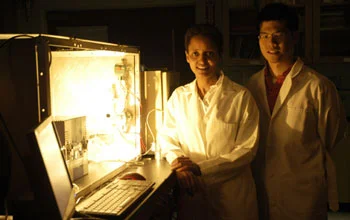
Sossina Haile and William Chueh next to the benchtop thermochemical reactor used to screen materials for implementation on the solar reactor. Image via CalTech

Sossina Haile and William Chueh next to the benchtop thermochemical reactor used to screen materials for implementation on the solar reactor. Image via CalTech

Converting H2O and CO2 into H2 and CO is a known process but doing it efficiently and cost-effectively has not been easy. Rare elements such as platinum or iridium have been used as catalyst so trigger the conversion.

Prof. Dr. Hansjörg Grützmacher and Dr. Monica Trincado. Image via ETH Zurich

Prof. Dr. Hansjörg Grützmacher and Dr. Monica Trincado. Image via ETH Zurich

Numerous projects are underway at ETH Zurich to find ways to harness hydrogen more efficiently and to produce solar fuels effectively. One of the most recent successful projects was completed by Prof. Grützmacher and his research group. The team discovered that formaldehyde can be used to store hydrogen.

Developing ways to harness renewable energy sources requires knowledge of how to first produce the fuel efficiently, then to store it and distribute it. The abundance of solar energy direct from the Sun makes it a very compelling choice. Finding the most effective way to do this would have tremendously beneficial results.


What's Your Carbon Footprint?

Elf

Carbon footprint is a term that has come into more common usage in the last decade. What does it mean? Let’s take a closer look.

Photo via Getty Images

Carbon footprint refers to the amount of carbon dioxide and other carbon compounds emitted due to the consumption of fossil fuels by a particular person, group, event, product or organization.

Typically, carbon footprint refers to the amount of greenhouse gases, especially carbon dioxide, released into the atmosphere by a particular human activity. Carbon footprint is usually measured as tons of CO2 emitted per year. This number increases when you add CO2-equivalent gases, such as methane, nitrous oxide and other greenhouse gases.

Consumption of fossil fuels and electricity play a large role in determining your carbon footprint.


How to Calculate Your Carbon Footprint

Your individual carbon footprint can be affected by many factors. Fossil fuel use and electricity consumption play a major role in your carbon footprint. Online calculators help in providing rough estimates based on factors such as:

• size of your household
• efficiency of appliances
• how much you drive or fly
• what you eat
• how much you recycle

While this is an approximation and not perfect, this can give you a good way to measure your activities and thus know how much CO2 you generate via these activities and and to figure out steps you can take to reduce your carbon footprint.

You can estimate your carbon footprint using these tools:
https://www.carbonfootprint.com/calculator.aspx
https://www3.epa.gov/carbon-footprint-calculator/


How can I reduce my carbon footprint?

Many daily activities such as electricity usage (home energy), car driving (transportation) and trash disposal (waste) all cause greenhouse gas emissions and contribute to your household's carbon footprint.

You can reduce your carbon footprint through your personal choices such as:

• driving more-efficient vehicles and maintaining existing vehicles
• using energy-efficient appliances
• insulating your home to reduce heating and air conditioning costs

Individuals and companies also purchase carbon credits to offset their usage. The money raised from this goes into projects such as planting trees or investing in renewable energy. Additional information and resources are available here: https://www.carbontrust.com/resources/guides/carbon-footprinting-and-reporting/carbon-footprinting


Try it Out: Get a Rough Estimate of Your Carbon Footprint