Contact Us

Have an inquiry? Please send us a message.


123 Street Avenue, City Town, 99999

(123) 555-6789

email@address.com


You can set your address, phone number, email and site description in the settings tab.
Link to read me page with more information.

News

News from Elf, a digital creative agency at the intersection of the arts and sciences.

Filtering by Category: Industry Insight

Design-Driven Companies Outperform the S&P by 219% over 10 years

Elf

designhexagon
When you do the common things in life in an uncommon way, you will command the attention of the world.
— George Washington Carver

Design is a key differentiator in driving business success and customer engagement. In a study conducted by the Design Management Institute reviewing business performance for design-driven companies as compared to the S&P Index over a decade (2004-2014), design-driven companies consistently outperformed the S&P by 219%.


Design-Led Companies: A Winning Business Advantage

A well-designed customer experience that is based upon deep customer understanding and provides effective, compelling visuals and relevant interactions, can make the difference between a loyal customer and one who walks away dissatisfied.

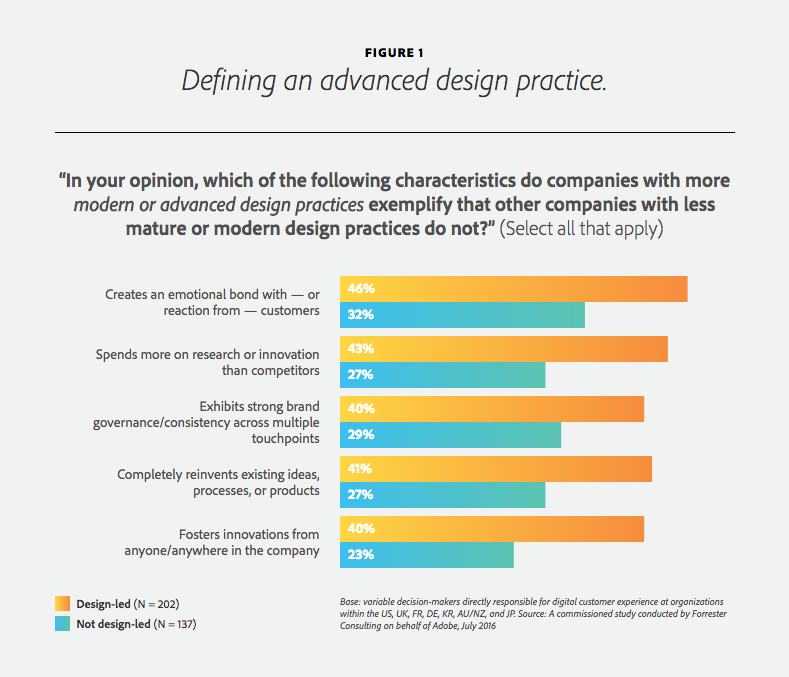
From July-Oct 2016, Forrester Research Consulting conducted a study commissioned by Adobe to explore how design practices may create a tangible, measurable business advantage. To do this, Forrester developed a design maturity framework to evaluate how companies use design in their business practice for marketing, product and customer experience. This included interviews and surveys of decision-makers at companies in the United States, United Kingdom, France, Germany, South Korea, Australia/New Zealand, and Japan. 

The study resulted in identifying 2 different categories of business - design-led firms versus those that did not place a priority on design.

What’s a design-led company?

A design-led company is one that puts design at the core of its brand. The company weaves design principles into everything it does— from research and strategy to creating content. Leadership and management at these companies think beyond transactions and focus on creating beautiful experiences that build lasting and meaningful relationships with customers. (Source: Adobe)


Design-led companies reported:

41% higher market share

46% competitive advantage overall

50% more loyal customers

70% digital experiences beat competitors


Key findings revealed that in design-led firms:

  • Design permeates the organization, driving culture and the ambition to do better.

  • There is support throughout the organization to nurture talent and to have a variety of skills from strategic to visual, technical and more with collaborative work processes.

  • The company embeds tactical and production-level design from strategy through application across user experience.

Also companies with less advanced design practices typically underestimate the business benefits of design-led customer experience.


Design-led firms excel at world-class customer experience strategy and implementation.

Leadership at design-led firms also have a keen awareness of the importance of design in creating an enjoyable customer experience that customers love and want to experience again. In fact, most design leaders interviewed consciously put customers first and emphasized the importance of creating an emotional bond with customers and having an advanced design practice to help support this.
forresterdesignpractice

Companies that prioritize design are also more likely to innovate and test ideas out with customers. They also invest in tools, training and systems to do this, and have design practices and processes in place to support their customer experience strategy.

Design-led firms also consciously aim to create seamless customer experiences across a variety of touchpoints and devices. Today so often customers begin a product search with a phone call, website visit from a desktop computer or visit to a store and then follow up on a smartphone or tablet. Your new customer may interact with your brand across multiple touchpoints before making a purchasing decision. Creating a seamless customer experience that adapts to how your customer finds and interacts with your business is key.

Disrupting Industries and Transforming Businesses

Design-driven startups have also disrupted industries. Uber transformed the transportation industry with a well-designed app to connect riders to drivers, while AirBnB also disrupted the hospitality industry with the idea of home rentals through an elegant website and mobile app. These companies definitely had innovative ideas, but they were able to pull in and engage customers through exceptional design and swift, intuitive user experiences.

Personalized Touch

Great design works hand in hand with great content. Your audiences connect with your company via excellent content that is personal and speaks to them individually. Together this leads to an engaging, enjoyable customer experience. This in turn,  drives connection, loyalty, ongoing engagement and revenue. 

Showing you care about your customer requires empathy and listening. In talking with your customers, you'll learn more about the decisions that led them to buy in the first place. You'll discover what both their expressed and unmet needs are. Sometimes, this in turn, will help you create a better product or service. These kinds of conversations and insight always drive better customer experiences.

Design Maturity

Through its study, Forrester identified companies with significant design-led practices as possessing 'design maturity.'  A company with design maturity prioritizes design, putting design at the core of its culture and customer experience, invests in people and processes and is constantly learning and improving. This in turn, differentiates the design-led company from others and wins over the customer by often a large margin. (Source: Adobe).

designmaturityforrester

Stand out in an increasingly competitive landscape with growing digital touchpoints and increasing customer expectations with design. Assess your brand's design maturity and follow the recommendations below to deliver best in class, design-led digital experiences that help you drive business results and growth.

When you have a design-led company, you can attain more satisfied and loyal customers, significant competitive advantages and greater market share than companies with a less mature design approach. You will also build an atmosphere that encourages innovation, continuous improvement in process, product and customer experience.

What You Can Do

If you are a C-level executive, manager or owner, here are a few recommendations to help you bring design to the forefront of your business and gain this competitive advantage over the long term.

1.) Include a variety of design roles

This ranges from visual and interactive design to research, interactive wireframing, and other processes that can help you uncover customer needs, plan and map out customer goals and execute customer experiences. Keep your definition of design broad so that you are not limited.

2.) Encourage design leadership across roles

Hire, train and support design leadership through training, mentorship, recruitment and support so that you bring in design thinking for continuous improvement.

3.) Establish cross-functional design processes

Add design capabilities throughout your organization from initial conceptualization to final execution.


When you lead with design, you end with great results.


Get in touch with us at business@elf.agency or submit an RFP.

The Connected Car

Elf

volvohaydens

We’ve become accustomed to the conveniences offered through our smartphones and tablets, keeping us connected and aware whenever we want. It’s also simplified and streamlined many aspects in daily life. Need groceries delivered? There is an app for that. In fact, there’s an app for practically anything you need to get done. 

How do you feel though when you get into your car? Does this remarkable ease of use fade away? Are you frustrated by returning to your pre-digital world? How much interactivity do you want and how? 

We are interested in questions like this. The Connected Car has been a growing topic of interest particularly in the last two years, offering opportunities for creating better driving and passenger experiences with relevant traffic information. It also provides marketers a way to gain real-world access to consumer behavior and preferences. In an insightful piece in 2015, Ad Age explores four areas of interest for marketers, such as audio, video, custom services marketing and personalized location targeting.

Elf: Designing for an Integrated Car Experience

One thing we’ve been keen on is the integration of tech in the car dash. Since 2015, our founder Jan Manon has been working on automotive UI design for select automotive manufacturers to provide a more ‘integrated’ car experience in Schweiz. With the upcoming launch of our new Hayden’s podcast this year, we are also keen on providing a seamless audio experience for passengers. We are eager to provide better design and innovative design elements as we bring digitization into the car.

Geneva Motor Show

Since 1905, the Geneva Motor Show has offered an avenue for introducing new automotive design and manufacturing for top models and companies every year. From the buggy-styled Clement in 1905 to Fiat, Jaguar, Alfa Romeo, Mercedes, Mayback, Ferrari models over the years, the Geneva Motor Show brings together automotive enthusiasts all over the world. This year our engineers were happy to attend. It was a busy 2 week-long event with over 600,000 visitors, 900 new car models and 175 new car concepts and models unveiled from Peugeot to Aston Martin.

Electric Models & Greater Efficiency 

This year there were several electric models as well as several manufacturers make the move to all-electric vehicles. Car companies such as Peugeot, Fiat, BMW, Hyundai and others showcased hybrid vehicles and energy efficient models.

porsche

Porsche Panamera Turbo S E-Hybrid (above)

Bentley Exp 12 Speed 6e Concept (above)

This is an all electric convertible, showing Bentley’s ongoing switch to electric-powered vehicles, starting in 2018 with the Bentayga plug-in hybrid drive train.


Futuristic Design 

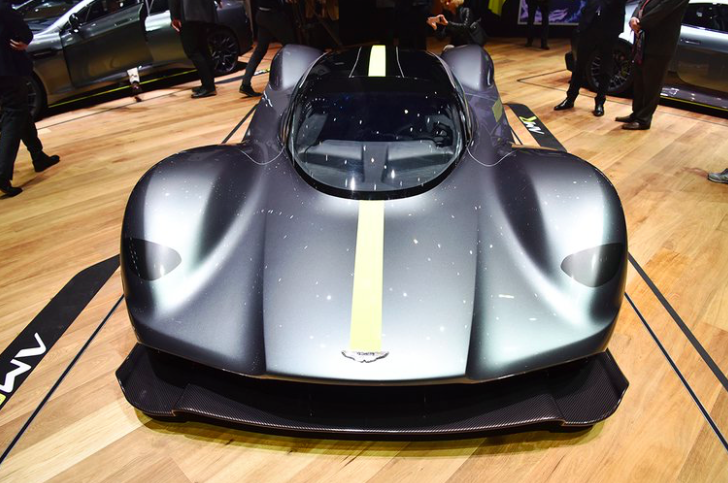
There were also some futuristic designs such as Aston Martin’s hypercar, Valkyrie below that is a limited edition vehicle with only 150 units for the road and 25 track-only versions.

valkyrie
valkyrie2

Aston Martin's Valkyrie (above)

We also loved the sleek futuristic design of the Dendrobion EV model below.

dendrobium.jpg

Dendrobion EV (above)


Some of Our Favorites:

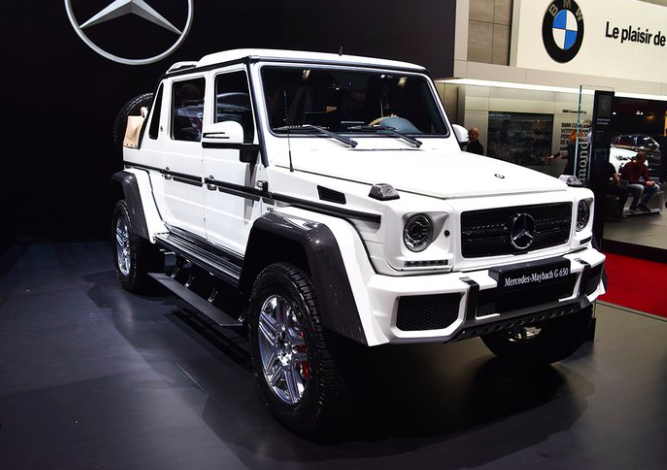
Below are some of our other favorites from the show. This includes a Mercedes Maybach G650 Landaulet wagon, Mercedes GT C Roadster Edition 50 and Aston Martin BB11 - all great for cruising through the city or in the mountains as well.

Mercedes Maybach G650 Landaulet

Mercedes Maybach G650 Landaulet (above)

Mercedes GT C Roadster Edition 50

Mercedes GT C Roadster Edition 50 (above)

astonmartin_DB11

Aston Martin DB11 (above)
We're big fans of the DB11 model with a beautiful chassis and new tech integration.

We're excited to contribute and design new interfaces for cars in 2017 and beyond!


Rippling Changes in the Auto Industry

Elf

Dramatic change is underway in the auto industry in recent years. There have been significant changes to the auto industry in the last 7 years, ranging from environmental factors to innovative design and the introduction of 'over the air' software updates and online ordering for cars by Tesla. The demand for digitization fueled by changes in other areas of a consumer's day-to-day life, has now found its way to the car.

Japanese Earthquakes Affect Supply Chain

From April 14-16 of 2016, Japan was rocked by two massive earthquakes along the Kumamoto Prefecture on the island of Kyushu. This event not only ripped apart the island, destroying properties and causing utter devastation in its wake, but also ground automotive production in Japan to a startling halt. As a primary producer of complete vehicles and parts supplier for Toyota, Lexus, Prius, GM and many other automotive brands, Japan’s automotive industry drives the delivery and supply of cars all over the world. The immediate aftereffects included shutting down plants and suspending production, causing delays and shortages in the supply chain that rippled across the auto industry worldwide. Now a year later, manufacturers have united to form a strong, cohesive network to provide automotive parts in the likelihood of disasters or unexpected events. Several manufacturers have also considered moving plants or setting up alternate production plants in other countries or locations.

Autonomous Driving Software

Since Tesla’s launch of autonomous driving software, more and more tech companies are looking to collaborate with automakers to drive innovation and reinvent ground transportation for the digital age. Japanese automotive components company Denso has invested heavily to support early stage technologies to support autonomous driving and improve cybersecurity in cars. Since 2011, the number of tech startups in transportation has doubled.

While high tech has been in the auto industry primarily as a supplier for a long time, it's only now that these companies are entering the market as direct competitors, according to Egil Juliussen, director of research at IHS Automotive, who has been tracking the changes in the automotive industry worldwide and particularly in car technology. In fact, the number of cars with connectivity has jumped to 81 million since 2015 and is expected to grow as much as 345 million by the year 2022.

New Opportunities Available in Auto Tech World

Given this new market potential with huge players from both the automotive and technology industries, it is clear that exponential growth is inevitable as smart technology integrated into cars becomes standard.

Japan Provides Great Beta Test Environment

In Japan where technology already plays such a significant role in the lives of consumers on a daily basis, this next step is not only natural but will be faster than in other areas of the world. This offers an unprecedented opportunity for auto manufacturers, technology companies and most notably, individuals who recognize this and take action to provide solutions. The Japanese market also offers a viable and fast beta testing environment for constant improvement, iteration and delivery. 

Technology Driving Inventory Management

Additional areas of improvement in the automotive world where technology can provide better solutions include inventory management. For example, after the earthquake in Japan, Toyota and Nissan both developed supply chain databases to protect themselves against unexpected losses and to monitor usage and supply better.