Contact Us

Have an inquiry? Please send us a message.


123 Street Avenue, City Town, 99999

(123) 555-6789

email@address.com


You can set your address, phone number, email and site description in the settings tab.
Link to read me page with more information.

News

News from Elf, a digital creative agency at the intersection of the arts and sciences.

Filtering by Category: Industry Insight

Amazon Adopts AR Kit in its latest iOS Shopping App Just Before Black Friday

Elf

With Virtual Product Previews, Amazon's shopping app gives customers the ability to see how products look inside their home using AR technology.  

Amazon employs Apple's AR Kit in its latest iOS app to let you view thousands of products in your home, before you buy them. Just in time for the start of the holiday season, the updated app uses augmented reality (AR) kit technology to help customers make better shopping decisions based on aesthetics and fit within their existing living spaces.

After opening the app, you click on the camera icon and choose AR view. Then you can select from thousands of items for your living room, bedroom, kitchen and home office. This ranges from electronics to kitchen appliances, home decor, toys, furniture and more. A nice feature of the app is the ability to move items around and get a full 360-degree view, which can help you finalize your purchase decisions so that you are choosing the best products for your personal aesthetics. Using the new app's AR Kit technology (version 9.21.2) requires iOS 11 and is compatible with the iPhone 6S or newer models.

Image via Amazon

Image via Amazon

AR Kit offers tremendous opportunities for showcasing products and building spaces and environments. This ability to recognize objects and showcase them virtually in context, is helpful in a variety of industries, ranging from retail to architecture and construction, landscaping, aviation and the automotive industry.

AR Kit can determine surfaces that any object is placed on and track the movement of the camera in relationship to its surroundings, using the rear camera feed and Core Motion data. In addition, AR Kit can also figure out the right lighting for virtual objects placed into a scene.


How Amazon's Purchase of Whole Foods Is Poised to Reinvent the American Retail Landscape

Elf

Amazon’s $13.7 billion dollar purchase of Whole Foods earlier in August offers unprecedented vertical integration in one of the largest industries in the country - grocery shopping.

whole-foods-amazon.jpg

Amazon's recent acquisition of Whole Foods surprised many and put grocery chains on alert. Why would the e-commerce giant spend $13.7 billion to acquire Whole Foods' 460 brick and mortar stores while slashing prices? The answer lies in Amazon's expansion into grocery retail, the largest category of consumer retail and the biggest untapped market for Amazon. Getting Whole Foods grocery store customers offers Amazon access to a larger retail market with persistent demand and access to a wealth of data to inform its expansion. It's clear Amazon believes that the future of grocery shopping lies online.

By slashing Whole Food prices by as much as 43%, Amazon can offer healthier food options affordably to larger markets in areas typically dominated by grocery supermarket chains like Kroger, Walmart and more. Supermarket chains lost $12 billion in value after Amazon's announcement to slash Whole Food prices. The grocery stores had already taken a massive hit after Amazon's purchase of Whole Foods was made public.

As Amazon acquires new Whole Food customers, the company also expands its core business based on free delivery services through Amazon Prime. Amazon Prime is a popular subscription option for just $10.99/month or $99 for the year and in use by 80 million Americans annually, according to 2017 data estimates by the Consumer Intelligence Research Partners (CIRP) firm. Amazon announced that Amazon Prime will become the customer rewards program for Whole Foods customers, thus giving special savings and in-store benefits to Prime members. Amazon hopes to convert Whole Food customers into Amazon Prime members.  In essence, the company has found a way to vertically integrate consumption. How many companies do you know that offer you options to buy the latest book you want to read, watch movies for free (through your Amazon Prime subscription), send a gift to a family member, order groceries and buy clothing, home appliances and technology products all on the same site? 


Anticipating Grocery Needs and Desires via Access to Consumer Data and Insight

Your purchase habits and even browsing history are not going unnoticed. Amazon already uses that information to help provide you with better recommendations for products you may want to have right away or later. Amazon is arguably the world’s greatest organizer of consumer data - both purchasing and intent - already. Adding fresh groceries and the power of a well established brand such as Whole Foods, offers a whole new level for the technology giant to compete at and a segway into the $800 billion dollar annual food and beverage marketplace.

Amazon is already masterful in providing useful recommendations. These recommendations can now extend to your grocery shopping, including replenishing supplies when low or finding and ordering groceries for recipes on the go or using Alexa. Since Amazon already remembers your purchasing history so well, you can benefit from discounts, coupons and other privileges that you do not have to the same degree with your local grocery store. This incentive in turn, encourages you to shop more with Amazon online, enjoying both convenience and better pricing. For Amazon, this leads to more customers, greater customer retention and a longer, more rewarding customer lifecycle.

Purchasing Whole Foods helps Amazon gain even more data, specific to grocery shopping. Amazon's mastery of how to leverage data is already apparent in its booming e-commerce business. Access to Whole Foods' customer data will help Amazon better understand the needs of customers, predict new behavior and create a long-lasting, loyal customer base.
 

Amazon_Whole_Foods.png

Whole Food data helps Amazon understand the grocery buying habits, patterns and preferences of customers. This insight adds to Amazon's ability to see the connections between different product purchases across categories. All of this data in turn, provides more insight into the needs and wants of customers.

Grocery shopping is something most people do every week. Unlike e-commerce products such as technology or apparel, grocery shopping is essential, frequent and also habitual. This kind of insight into consumers is very valuable as it enables Amazon to tailor individual grocery shopping experiences. Amazon can also upsell other products like it is already doing at Whole Food stores by offering Amazon Echo products right next to fresh produce. While selling technology products next to grocery store items may not be easy at a local grocery store, this combination and others may grow in popularity now through Amazon.

Existing Whole Foods customers also are considerably more affluent than shoppers at other grocery stores, with $1000/month available in discretionary income on average, according to Business Insider. Upselling new products is a natural next step, as well as offering convenient delivery services same day through Prime Now or in the next two to three days via Amazon Prime.

From a customer's point of view, Amazon's purchase of Whole Foods offers convenience. For example, if a customer just finished a favorite snack or grocery staple, Amazon will then remind the person to buy more right when he or she needs it. With just a click of a button, you can have it delivered to your doorstep - no driving, no fuss.


Photo of Whole Foods CEO John Mackey via AP

Photo of Whole Foods CEO John Mackey via AP

Disrupting Existing Grocery Store Chains

How will Amazon's purchase of Whole Foods and expansion across the country, change existing grocery store chains? While the full extent of Amazon's entry into the retail grocery store marketplace remains to be seen, some changes can be predicted. Existing stores and big grocery chain giants such as Kroger, Costco and Walmart will have to compete with Amazon's known brand quality assurance and speed as well as ability to offer lower prices. 

Amazon is known for its swift, easy and personalized shopping experience. With just a click of a few buttons, you have ordered what you wanted, discovered a few things along the way and got the best prices and quickest delivery. 

Why would you want to shop anywhere else?

Grocery stores may slash prices in certain categories and items to keep pace with their new rival. They may also go out of business if they cannot adapt quickly enough or are unable to recognize the areas that they can excel in and dominate.

In other industry sectors, Amazon already owns several brands of its own, particularly in apparel such as Lark & Ro, Ella Moon and Ma and others and even its own movies such as Manchester by the Sea. Companies like Kohl were forced to adapt quickly by creating their own private labels - basically their own differentiated product - so that they could survive and thrive. After numerous mishaps, Kohl's private brand now accounts for 50 percent of all of its sales.

Grocery stores may also have to adapt in a similar fashion by providing more groceries with their own brands that their customers love.

In the immediate interim, customers can still continue to shop right at the 460 Whole Food stores available in 42 states that now fall within the Amazon family. In some respects, this will help customers who may be reticent about buying groceries online to keep purchasing at their favorites stores - just at more affordable pricing and with better discounts and access to other products via Amazon.

Accelerating Food Delivery Services to Your Home

Food delivery via Amazon is already a popular service, whether done online or via the mobile app. With the ability to order groceries now and also have same or next day delivery, Amazon is now a top competitor for providing groceries - something you need every week. The company still offers its personalized, speedy and secure checkout process online, which in many ways, is better than a direct purchase within a store. 

A customer can also stay on budget, buy just from a pre-planned shopping list and place orders quickly without waiting in long lines or trying to find a parking spot in a crowded grocery store parking lot after work.

Lower Prices and Access to Healthier Food More Affordably

One of the biggest arguments for a person to continue to shop at any given grocery store is the cost of food. Buying locally often saved the customer money as there was no shipping cost involved. There may be a cost for traveling to and from the store. Purchasing healthier food typically involves higher costs. Healthier food is often more expensive than versions filling most grocery aisles today that are loaded with saturated fats, GMO, high fructose corn syrup and synthetic ingredients that are hard to pronounce. Even as public education about nutrition and food quality has improved, cost has remained a significant barrier to buying healthy food.

Amazon did not delay in taking action to address this. Within just three days of the FTC approving Amazon's purchase of Whole Foods and its first day as new owner, Amazon slashed prices by as much as 43 percent! While some products remained the same, there were significant changes to prices on popular and quickly consumed foods such as bananas, eggs, avocados, chicken, beef, salmon and more.

Pricing was formerly a barrier to entry for new customers at Whole Foods and Amazon's lowered pricing has had an immediate positive effect for consumers while disrupting the food retail industry.

Amazon's bold move offers a way for consumers to have access to healthier foods more affordably. It also forces food retailers to adapt quickly and come up with more effective pricing strategies.
 

Photo via Whole Foods on Facebook

Photo via Whole Foods on Facebook

Changing the Suburban and Strip Mall Landscape

Without a doubt, Amazon's foray into the grocery store marketplace will have a tremendous impact upon the industry. But its reach extends beyond just brick and mortar grocery stores to their environments. Many grocery stores are in suburbs or in strip malls. As customers buy more groceries online, they will be less likely to spend their time in strip malls. There will be fewer physical grocery stores, just like the disappearance of bookstores over time after Amazon changed the way people discover and buy books.

Maybe former strip malls and grocery stores will be converted into distribution centers or fulfillment centers. Recently, Amazon filed a patent application for drone towers in city centers. These drone towers will have their own warehouses and loading docks. 
 

Amazon Will Have to Grow Its Own Distribution Networks

Finally, in addition to its effect on grocery chains, Amazon's purchase of Whole Foods will also require that the company build better distribution networks across the country. As Amazon builds this and supplies customers with fresh groceries, recommended items and other products on their wish lists, food retailers across the country will also have to adapt in providing speedy delivery and high quality products at lower prices.

In conclusion, Amazon has raised the bar in terms of convenience and affordability and in anticipating consumer needs and desires with its vertically integrated, swift shopping experience personalized to each customer. At the very least, customer grocery store shopping experiences will improve. We can expect savvier shoppers and hopefully, healthier ones too.

How will the American retail landscape look in the years to come? While the answer remains to be seen, we would love to see some of these strip mall areas and former grocery stores turned into parks and community green spaces.


Designing for a Great UX when Mobile is First in Google Search

Elf

Elfmobilefirst

Mobile search has consistently grown year after year and Google has dominated mobile search results as the browser of choice among consumers, averaging 15 Billion searches a month in the U.S alone. In late 2016, Google released its first mobile-friendly update that boosted search engine rankings for mobile-friendly sites, while non-mobile friendly sites received decreased rankings.

Since Google announced its "mobile-first search" results indexing where mobile search results will take priority over desktop search results, the search marketing industry has been abuzz with interest and speculation when this update rolls out in full. Search Engine Watch, among other leading search marketing information companies, estimates that the official release will occur in the latter half of 2017 and into early 2018.

Two years ago, Google announced that mobile search surpassed desktop results. Since mobile is now the predominant way that people search on Google, it makes sense to offer an excellent mobile user experience. It's also clear that one of the issues Google is tackling here is poor usability in many mobile sites today. Improving user experience on mobile has become a top priority for Google search.

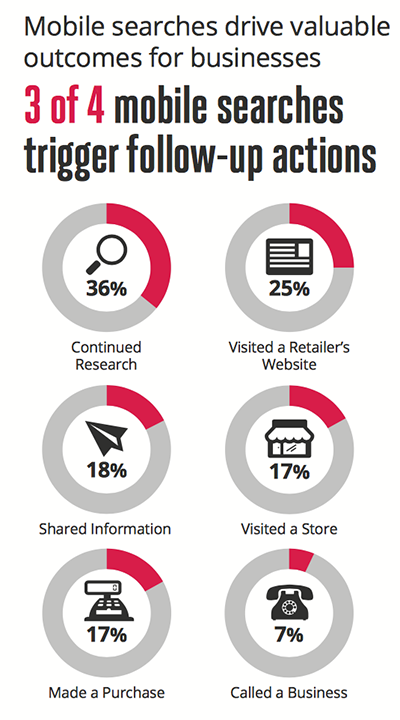
3 out of 4 Mobile Searches Results in Follow-Up Action

Mobile search is always happening on the go, at home and at work. Search is often tied to a specific context. A customer can also interact with your brand multiple times, starting search on a mobile device, and continuing on to a desktop interaction, telephone call or store visit.

As the following infographic from Think with Google indicates, actions triggered by mobile search happen quickly.

thinkwithGooglemobile

How do you improve the usability of your site?

Test Your Site

First test your existing site using Google's free mobile-friendly test tool at https://search.google.com/search-console/mobile-friendly. Just type in your website's domain URL and gain some insights about the mobile performance of your site - what's working and what you need to improve upon.

You can see an example here of our own site.

elfmobiletest

Content

This has to be easy to access - not pinching and zooming in for legibility. It also has to be succinct in length, to fit on the small size of a mobile screen.

Is your site content visible and accessible? Is your content consistent across your mobile and desktop versions?

Unified Site, Responsive Design

Some websites have deployed separate mobile and desktop versions with different URLs, dynamic serving and even a watered down version of their complete website for mobile devices. This hinders usability on mobile devices, requires more ongoing upkeep and can lead to a frustrating user experience for your customers, clients, partners and team.

Instead, using responsive design means that your site will be consistent across platforms and devices, adjusting to browser and screen sizes automatically. This prevents the need for future maintenance of separate URLs and technically, separate mobile and desktop sites.

Conscious Design

In addition to creating a responsive design that works seamlessly for both desktop and mobile versions of your site, you will also want to think about the layout of individual pages. For example, if you have an e-commerce site, avoid putting large content blocks at the top of a page with products towards the end. One way of designing this effectively is to add the product images first with a title, brief bulleted text and a 'Read More' or other labeled button that can be expanded upon for more information.

Page Speed

Google Webmaster Trends Analyst Gary Illyes confirmed in Nov 2016 that page speed is a factor in the next mobile update. Google already has been using page speed as a factor in terms of page rank and this will continue to be relevant when the mobile-first index is completely live and in use.

It's important to note that if a person is accessing your site without Wi-Fi and just dependent on a cellular connection, site access can be really slow. 

Check your site's speed using Google's PageSpeed Insights Tool or GTmetrix. Take necessary measures to address any slowness in page loading time. Your site should load in three seconds or less. Kissmetrics reported that 40% of web users will abandon a web page if it takes longer than three seconds to load.

Google’s introduction of Accelerated Mobile Pages (AMP) demonstrates its concern and commitment to improving page speed for mobile access. Your business can succeed in this mobile-friendly environment by providing a quick, user-friendly, AMP-ready user experience.

Knowing Your Audience

elfrealestate


Keep your audience in mind throughout your site so it is personalized and relevant. 

Real Estate and Home Improvement
For example, if your business is in architecture, real estate or home improvement, your site has to appeal to home owners and people looking to purchase or renovate their homes. Design is paramount in conveying professionalism, aesthetics and savviness. Your customers want to know that the company they are dealing with is capable of providing them the high quality and consistent service they expect. Your site's mobile readiness reflects your business' awareness and adaptability. A well-designed, mobile-friendly site with relevant content engenders confidence.

Tech Consulting
For a B2B business such as a tech consulting company, your site must be swift, tailored to your audience and get to the point quickly. Your audience is smart and knowledgeable. You need to convey essential information quickly and concisely.

Retail
In retail such as apparel or footwear, your customer expects a swift-loading mobile experience with large graphics, short descriptions and any promotions or discounts clearly visible. Today customers check online before going into a physical store to see if they can get a better deal and to learn more about the product they want to buy before an in-store visit.

Education
For universities and colleges, their customers are students and parents. Your site must therefore be appealing to both, proving the value of getting an education at your institution as compared to others and truly provide a compelling experience for students to want to attend.

Your Social Presence

The online experience you provide to your customers extends beyond your website to your social media presence. Your audience may visit your social media outlets (Facebook, Twitter and other outlets) to learn more about your company in a more personal and authentic way. This can be more important for Generation Z, Millennial and Generation Y audiences who look for socially engaged businesses.

Multimedia Results

As you may have already noticed, more images and videos appear in mobile search results, whether it is images from your Twitter Feed, videos from YouTube you showcase or other multimedia on your site. Consider this as you build your brand out and your ongoing marketing. 

Optimizing for Local

elflocalsearch

Mobile search helps local businesses differentiate themselves and win over new customers very quickly through a compelling mobile user experience. Voice search has increased significantly with Siri, Google Assistant and Cortana and is three times more likely in use for local search, according to Mary Meeker’s Internet Trends Report 2016 by Kleiner Perkins Caufield Byers. This increase is largely attributed to a significant improvement in technology that recognizes natural language along with access to larger vocabularies.

Data of Voice Search Usage from HigherVisibility.com

voicesearch

Consider your business and whether you have a lot of local search for your industry and product/service offering. If you do, having a local search strategy optimized for voice search can become a key differentiator for you. In addition to having a mobile-friendly site, also aim to target long-tail keywords and natural language keywords for your business. Verify your business on Google my Business. Make sure your contact information is consistent across your website, social media and any other relevant links.

In conclusion, by following these tips above you can optimize your website for your customers and be prepared for the full mobile-first rollout in the months to come.