Contact Us

Have an inquiry? Please send us a message.


123 Street Avenue, City Town, 99999

(123) 555-6789

email@address.com


You can set your address, phone number, email and site description in the settings tab.
Link to read me page with more information.

News

News from Elf, a digital creative agency at the intersection of the arts and sciences.

Filtering by Category: Apple News

Apple's Patent for Foldable iPhone with Display Could Launch by 2020

Elf

Apple's recent patent filing for folding iPhone with a flexible display that clips on to clothing has sparked rumors about a foldable OLED iPhone. A financial analyst who works with Apple suppliers in Asia estimates launch by early 2020.

Hayden's concept on flexible screen 2016

Hayden's concept on flexible screen 2016

Recent Patent History

2017 Patent: Flexible section in the middle of the Smartphone allows the entire body to bend without seams or a visible hinge

Back on Oct 12, 2017, Apple filed a patent for a new application with the U.S. Patent and Trademark Office called "Electronic Devices with Displays." The patent reveals Apple's interest in making devices that could be folded in half, describing a device with a 'flexible portion' that could be folded and would require having a 'flexible display' to do this without using seams or hinges. The USPTO application credits inventors Terry C. Shyu, Paul. S. Drzaic and Zhen Zhang for the flexible design and was issued to the patent office a year prior on Aug. 30, 2016.
 

Image via USPTO

Image via USPTO

The patent application describes a foldable display with an organic light emitting display layer (OLED) that is enclosed in a housing made from a variety of materials, ranging from plastic to glass, ceramics, fiber composites, stainless steel and/or aluminum. This latest concept could be applied to numerous devices ranging from MacBooks and iPads to Apple Watches and more.

Image via USPTO

Image via USPTO

Apple's patent filing also reveals that the technology can be achieved using next generation, micro LED display technology, which would also increase power savings for mobile devices. 

2016 Patent: Flexible OLED display with a Hinged Main Body

A year earlier on Nov 22, 2016, Apple was granted a patent No. 9,504,170 for 'Flexible display devices' that describe an Phone with foldable full-screen display. It's clear that Apple has been researching and experimenting with options for a hinged iPhone format with no visible hinges or seams, but instead having a flexible, OLED display with a metal backing that is capable of being folded into half. 
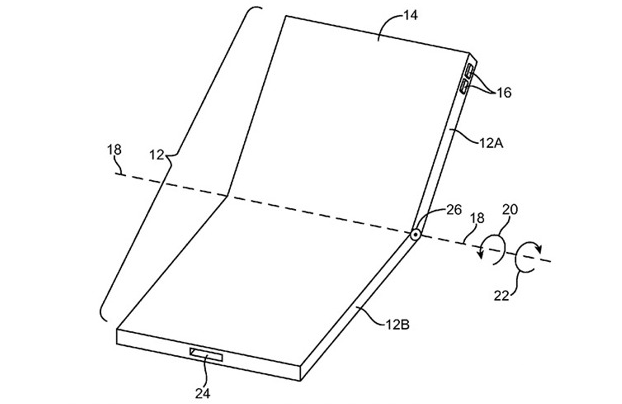
Image via USPTO

Image via USPTO

Apple's design would make it easier to fold the iPhone for easy storage similar to the clamshell cellphones that Motorola brought to mass markets in the '90s. In order to have a foldable format, Apple's design requires flexible components such as an OLED display with a metal structure for support. The patent proposes using nitinol, an alloy of nickel and titanium that is known for being elastic and having remarkable shape memory capabilities. The document also offers other options such as flexible polymers.
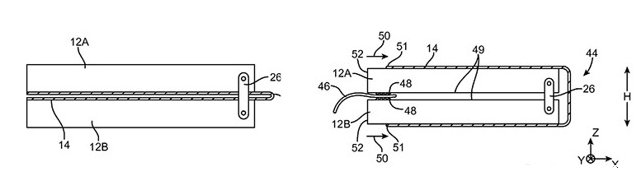
Image via USPTO

Image via USPTO

The patent goes into more detail about a device housing that has upper and lower sections, each of which is equipped with processors, sensors and smartphone circuitry. Upper housing could contain light sensors, cameras, display controllers and speaker modules. The bottom housing could hold microphones, CPU and GPU, a vibrator and other essentials. Both parts are attached via a hinge mechanism that allows for rotation and enables both parts to move together. The upper and lower housing are connected via flexible, printed circuit boards. The display is installed over the two structures and Apple documents how the flexible screen can include additional material for two or more folding options.

Image via USPTO

Image via USPTO

The new screen would be able to fold over itself similar to the clamshell cellphone, making it portable and also protecting the screen from weather and external elements. There is also a configuration for the display facing outward for easy operations. This second configuration allows for clipping on to a person's clothing via sawtooth detents. In order to prevent stress on the OLED part, Apple offers suggestions to ease tension with rollers to dispense and retract the OLED display when the hinge rotates. The patent describes two-hinge designs, cover glass and viewing angle details.
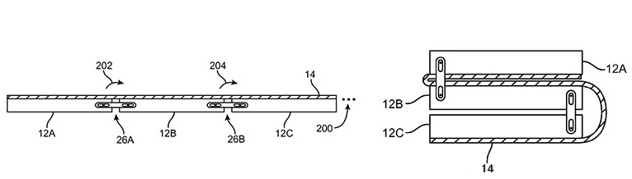
Image via USPTO

Image via USPTO

Apple's foldable iPhone patent was first filed in July 2014 and credits Fletcher R. Rothkopf, Andrew J. M. Janis and Teodor Dabov as its inventors.

Potential 2020 Release

The patent for this technology was first filed in July 2014, crediting Fletcher R. Rothkopf, Andrew J. M. Janis and Teodor Dabov as its inventors. While Apple has not shared any public details of its foldable smartphone concept, a financial analyst from Bank of America and Merrill Lynch, Wamsi Mohan, who works directly with Apple suppliers in Asia, suggests that the new foldable iPhone could be ready as early as 2020. Mohan also suggested that having a foldable smartphone and the trend towards larger iPhones in recent years could result in a smartphone that 'doubles up as a tablet." This device would offer the benefits of a larger iPad but the portability of a smartphone.

Collaboration with LG

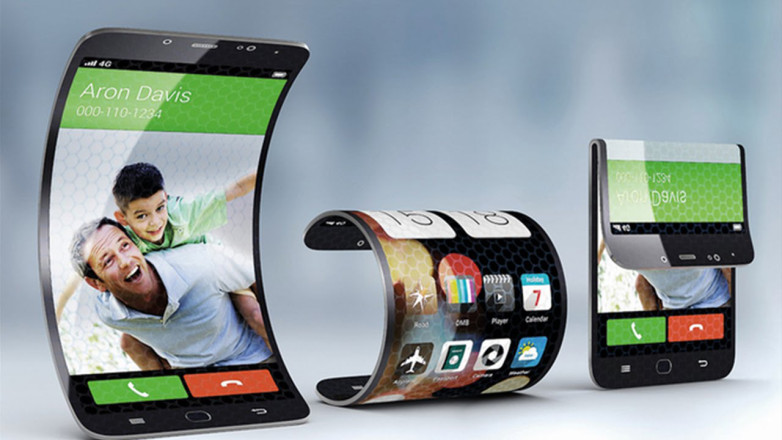
Apple's newest patent filing in Oct of 2017 also overlaps with rumors about a collaboration with LG where LG was making a foldable OLED panel and a "rigid flexible printed circuit board" for a future iPhone model. LG is known for its large, rich color displays and has been working on the problem of having a cohesive display without a visible hinge mechanism for several years now. Other manufacturers like Samsung have teased out concepts, though no working flexible screen model is available yet for purchase by consumers.
Concept via Samsung

Concept via Samsung

Concept via Samsung

Concept via Samsung

Concept via Samsung

Concept via Samsung

The new technology could also find its way into other product lines like the MacBook or iPad.

WWDC in June 2018

Elf

WWDC via Apple

WWDC via Apple

We are looking forward to WWDC or the Worldwide Developers Conference, scheduled to begin June 4 at the McEnery Convention Center in San Jose, CA. Each year, the event gets better and more elaborate, with detailed sessions. You can follow along with the WWWDC app.


WWDC kicks off in just a little over three months with an opening keynote each year where leading Apple engineers and executives preview the latest software versions of  iOS, macOS, tvOS, and watchOS.

Some updates that we can expect include:

  • iOS 12 release

  • upgraded Siri and mobile automation

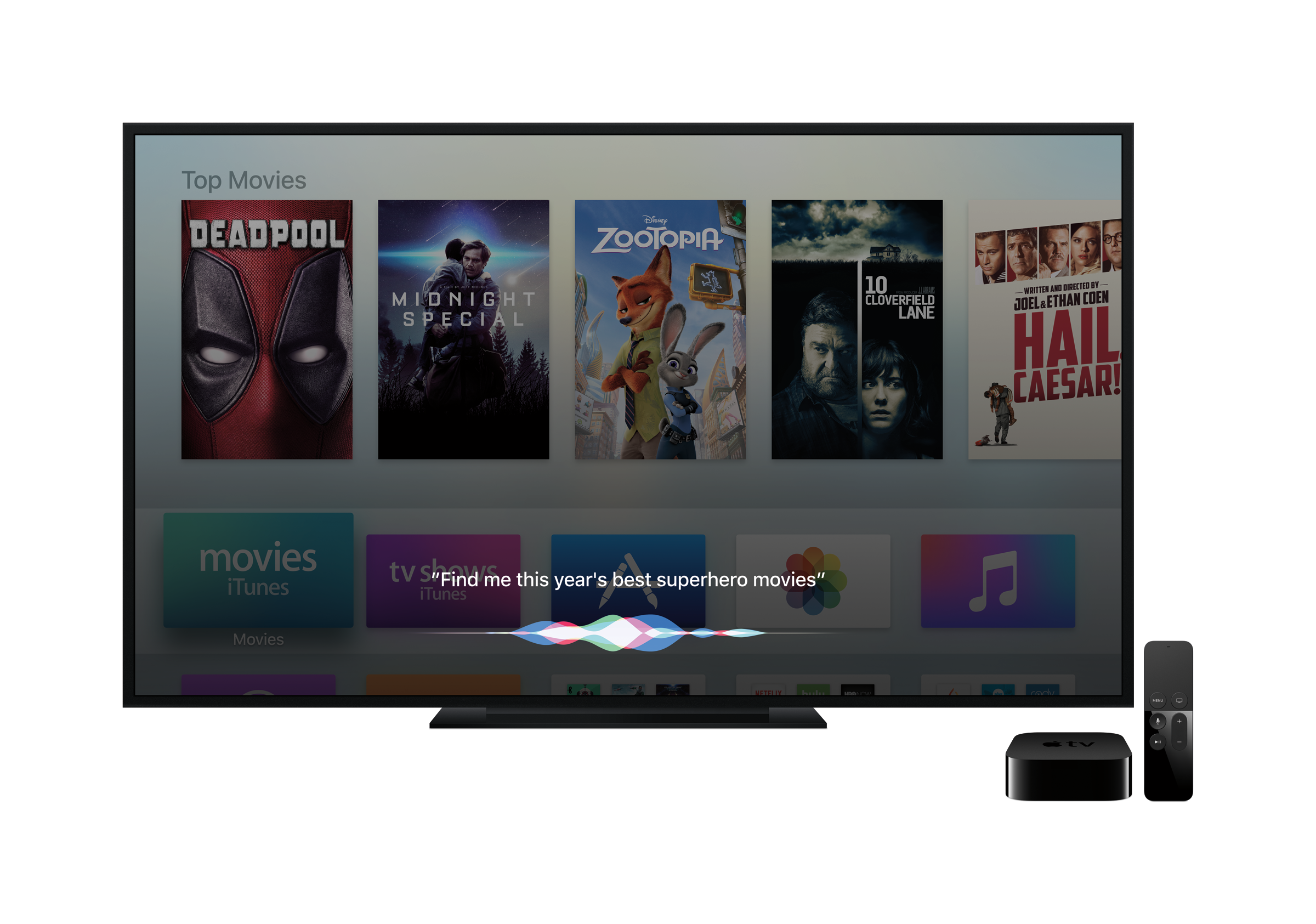
  • HomePod integration with Apple TV

  • possible new hardware from iPad Pros to A11X processors

Image via Apple

Image via Apple

iOS 12 Release

As in prior years, Apple is expected to release the next level of its operating system iOS 12 with a beta release available for download for developers earlier on and the full product release by September. Within the new system, mobile automation is expected along with more integrations and options for Siri via the Home app and HomePod.
 

Image via Apple

Image via Apple

Upgraded Siri and Mobile Automation

Siri lags behind other voice-activated artificial intelligence (AI) software services available to the public such as Amazon’s Echo and Google’s Alex in both recognizing voices and in executing commands. Improvements to Siri's voice assistant and automation services can be expected as they definitely need an upgrade. WWDC has always offered a platform for innovation and collaboration. Apple has also been working with IBM since 2014 on enterprise services and now has expanded to using IBM’s Watson to improve its AI functionality. This can be expected to positively impact Siri's performance overall.

One important aspect that has been overlooked in the news for a while now when comparing these different products that offer different services as well, is privacy. Amazon’s Echo and Google’s Alexa both use information provided by their users to update their AI software, thus increasing their AI capabilities at a much faster rate. Their AI softwares are able to respond faster and more intelligently because their massive data engines are more informed. However, the big question that has not been adequately addressed here is privacy. To get their AI software to learn the nuances of language and speech faster, conversations in your private home are becoming mineable data in these vast engines.

Apple has maintained a level of privacy that is not available via these other services, ranging from its entire OS ecosystem to now Apple News and its developing AI. This does allow you to feel more comfortable in the confidentiality of what you are sharing. 

The question then is how can Apple improve Siri without drawing upon private consumer information to teach its AI? That's where IBM's Watson comes into play and will hopefully be very helpful in accelerating Siri's understanding and response rate to voices and being able to deliver on what you ask Siri to do.
 

Image via Workflow

Image via Workflow

Another aspect that can help in this process is Workflow, the innovative company that Apple acquired last year. Workflow also won an Apple Design award. In a nutshell, Workflow essentially provides a graphical version of what Siri could do. You define 'actions' and then you trigger them with a 'touch' using an Apple device (includes Apple Watch). The touch in turn, triggers a complex action to be executed. By using Workflow's capabilities, Siri developers can build out functions that users can just launch with their voices or through simple touch on iOS devices. 

Image via Apple

Image via Apple

HomePod integration with Apple TV

We also expect HomePod integration with Apple TV where you can ask HomePod to play specific shows. This will enable developers to build new apps and games that respond to commands viaHomePod’s microphones.

Possible new Hardware from iPad Pros to A11X Processors

Apple may also announce new hardware at WWDC such as iPad Pros with TrueDepth cameras, possible replacement for the MacBook Air, new eight-core A11X processors and perhaps an updated iPhone SE 2. Apple already announced a budget iPad with A10 processor and Apple Pencil support at its March 27 press event at a Chicago school.

You can see highlights from last year's event that we reported on here - Part 1, 2 and 3.

Apple News: Ski and Snowboard Activity Tracking Update on Apple Watch

Elf

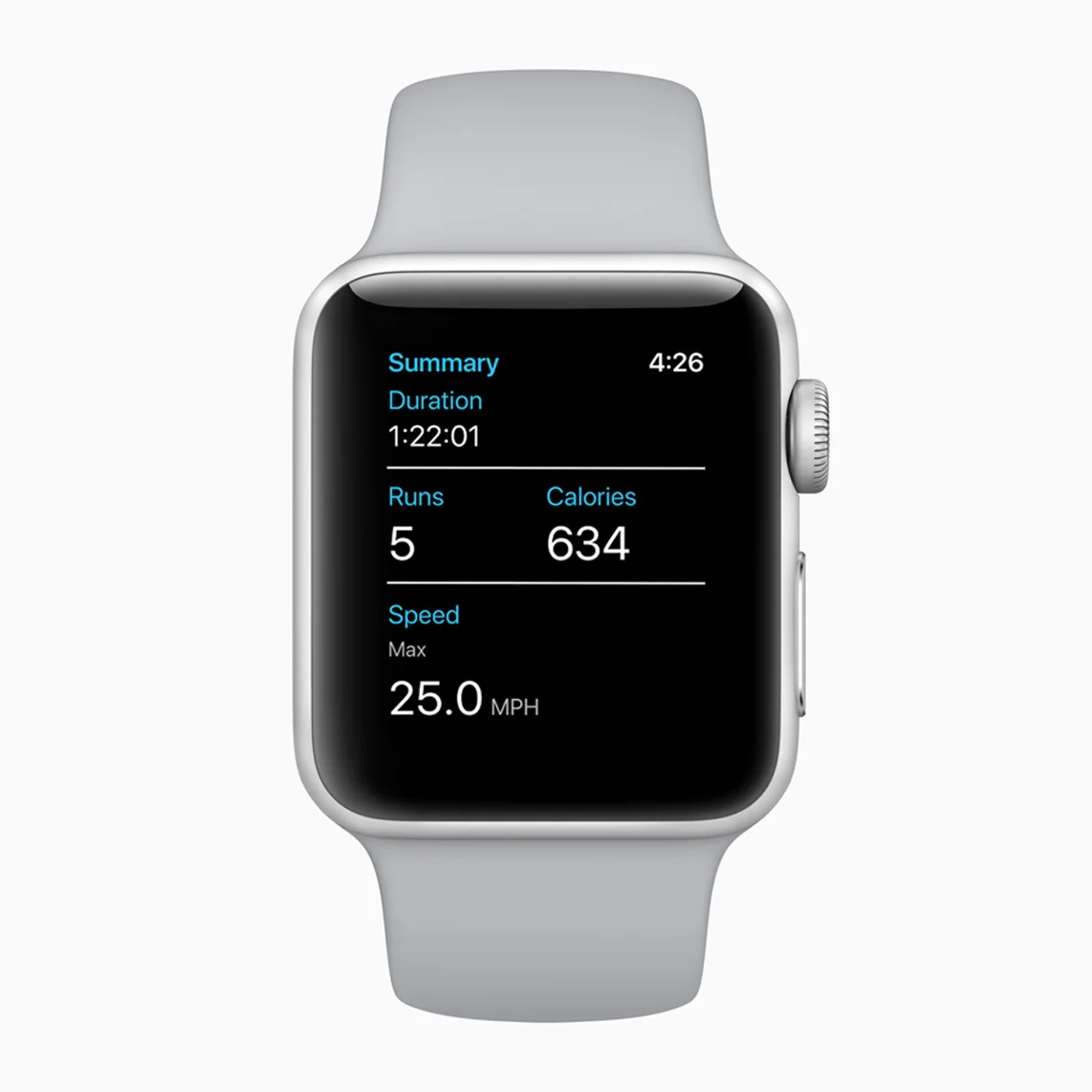
New updates to Apple Watch 3 make it easier to track skiing and snowboarding activity with activity contributing to the Apple Watch Activity app and shared with the Health app with permissions enabled.

Image via Apple

Image via Apple

We're excited by the new Apple updates to the Apple Watch 3 where we can track ski and snowboard activity. This helps us in the app we have been developing for the last few months of 2017 and into this year. 

Now we can track:

  • Total vertical descent and horizontal distance

  • Number of runs

  • Average and maximum speeds

  • Total time spent

  • Calories burned

image via Apple

image via Apple

Apple_Watch_Series_3_ski4.jpg
image via Apple

image via Apple

image via Apple

image via Apple

This helps in tracking active calorie measurements directly to your Apple Watch Activity app. You can record runs and see your vertical descent and horizontal distance as well as speeds. You can also save your workout info to your Health app. In addition, you can use Siri to track runs with your voice.

image via Apple

image via Apple

Our new ski app at Elf is suitable for anyone who wants to have a great workout skiing or snowboarding, track performance and improve over time. We are fortunate to have a wide variety of beta testers, ranging from college athletes to Olympic skiers and snowboarders in a variety of disciplines. We are eager to share our app with you when it is completed and ready for you - beautifully!